|
<< Click to display Table of content >> Advanced Meteo |
  
|
|
<< Click to display Table of content >> Advanced Meteo |
|
Introduction to the definition of weather by its physical parameters and stability class.
The method followed is that defined in the article:
Defrance, Jérôme & Salomons, Erik & Stuijt, Ingrid & Heimann, Dietrich & Plovsing, Birger & Watts, G.R & Jonasson, Hans & Zhang, Xuetao & Premat, Eric & Schmich-Yamane, Isabelle & Aballéa, François-Edern & Baulac, Marine & Roo, Foort. (2007). Outdoor Sound Propagation Reference Model Developed in the European Harmonoise Project. Acta Acustica united with Acustica. 93. 213-227.
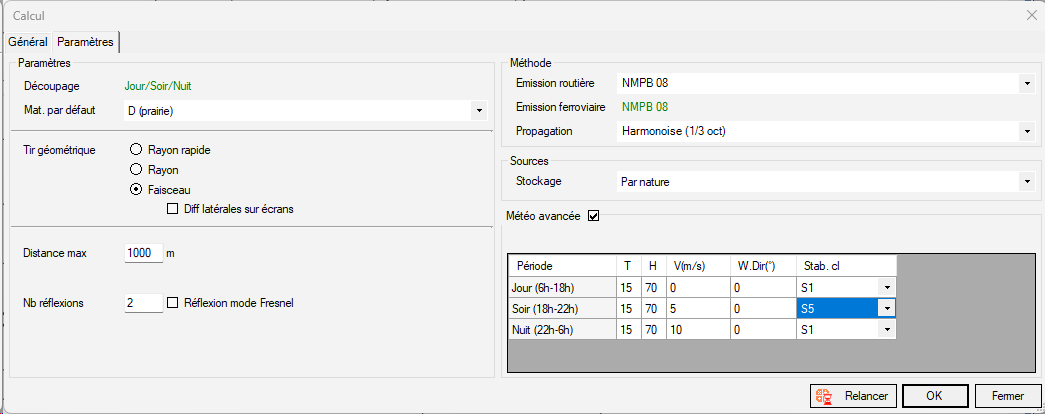
To access it, you must select a propagation mode following the Harmonoise method (octave or third-octave) and specify that you wish to define the parameters yourself, as shown here:
How to specify wind direction:
We have chosen to define wind direction by the heading of its velocity vector.
Thus, a northerly wind has its velocity vector oriented along the y-axis or towards the south; its heading is therefore 180°, and the parameter expected by MithraSIG in this case is 180.
Entering W. Dir of 0 therefore corresponds to a velocity vector pointing towards the north; it is therefore a southerly wind.
A westerly wind corresponds to a parameter of 90°, and an easterly wind to 270°.
Please Note:
Calculus can be longer than the one done iwith NMPB met